YouthCases Aid: supporting the staff around a young person’s court experience.
Better support starts behind the scenes
Organization
Parramatta
Children’s Court
ROLE
Staff App UX/UI Designer + Researcher
EXPERTISE
Four students · University capstone
Timeframe
April–July 2024


Overview
Our capstone started with helping young people understand legal orders. Research revealed that staff preparation and coordination were part of the same problem. I designed the Staff App within the team’s wider proposal.
Context and output
University capstone with research at Parramatta Children’s Court. High-fidelity Staff App prototype within a three-part team proposal. Our team was invited by an NSW project manager to continue developing the app.
Problem
Young people needed understandable information. Staff needed case context and expertise to support those conversations. The service opportunity extended beyond rewriting documents.
The document was only part of the problem
I focused the Staff App on preparation: finding relevant information and the right colleague before an interaction.

Research
Research across 12+ project participants included legal staff, speech pathologists, and caseworkers. Interviews, workshops, probes, and field studies explored communication across departments.
Learning within the limits of the setting
With photography prohibited during the court visit, we documented the setting through sketches. Privacy and access constraints shaped the research.
Further validation
These findings informed the concept. Broader validation with young people and other affected users would still be needed.
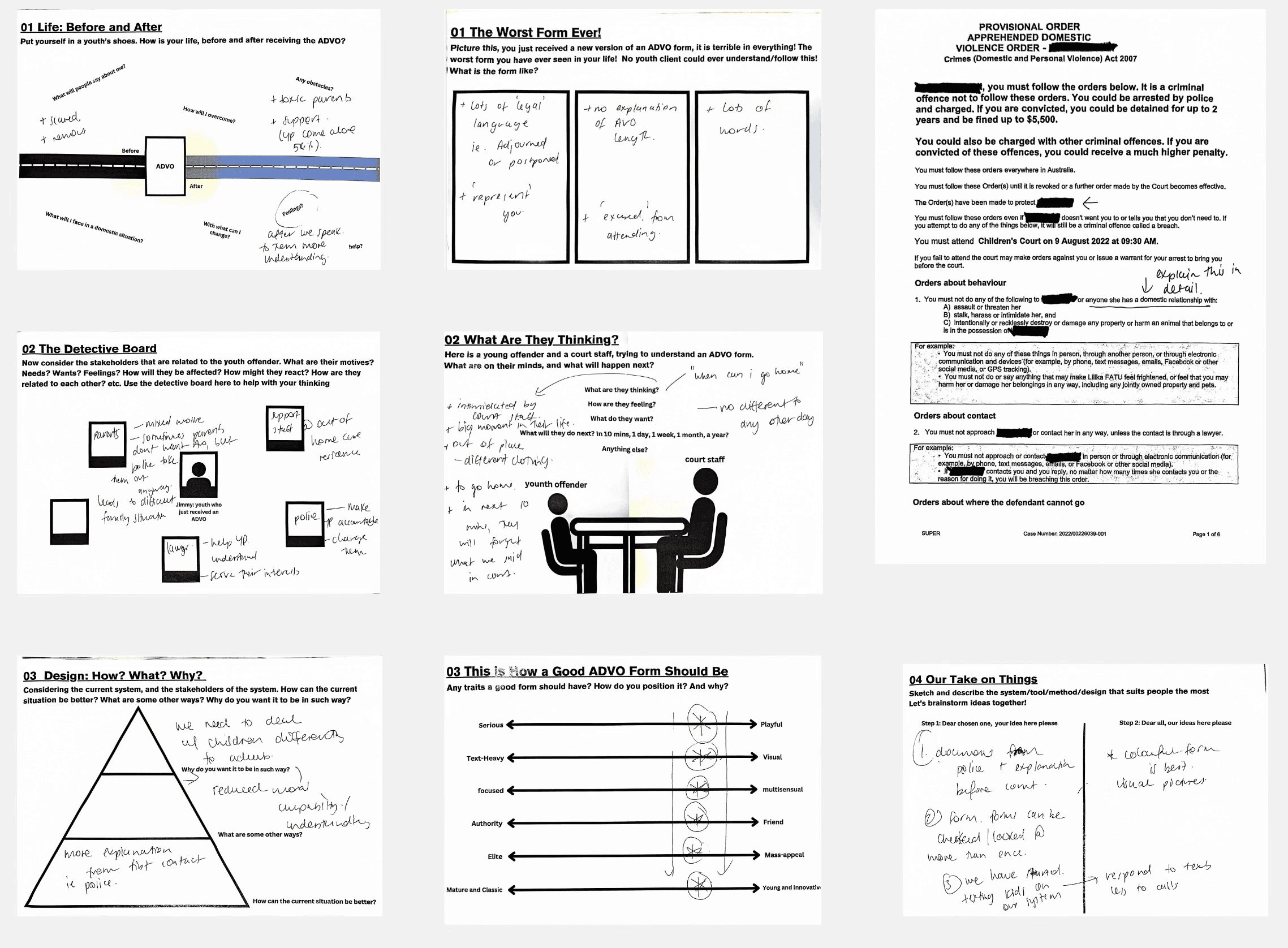


Ideation
The gaps were between people too
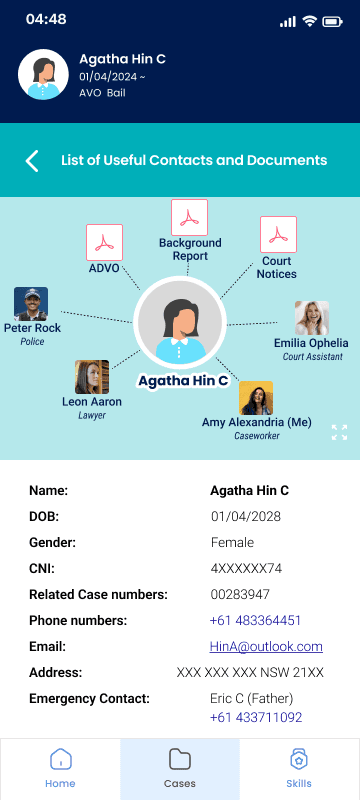
Synthesis highlighted fragmented information and difficulty finding expertise. I translated those themes into case context, colleague access, and learning within one workspace.
Three parts of one service idea
Designs
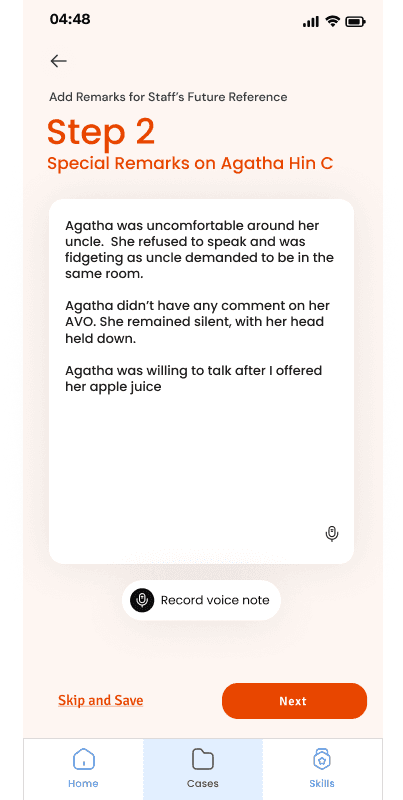
I grouped timelines, documents, contacts, and remarks around the case so staff could prepare with relevant context.
Prepare with the context that matters
Structured prompts supported observation entry. The key trade-off was consistency without turning observations into fixed labels about a young person.
Shared information needed boundaries
I represented access around staff involvement in each case. Shared context needed boundaries as well as visibility.
Review before implementation
These concepts would require information-governance review and technical verification before implementation.
Make expertise easier to find
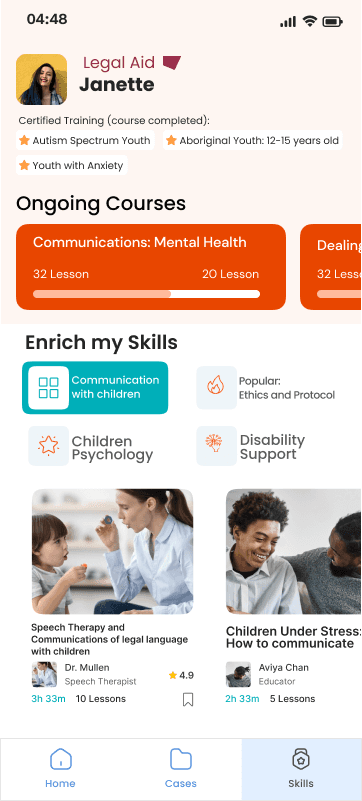
Staff profiles surfaced skills, experience, and learning for human allocation decisions. Training and expert guidance supported preparation within the same experience.
Human judgment, not automated decisions
The interface supported human judgment about assignments; improved fairness or efficiency was not established.
Prototype
Making workflows tangible
Wireframes and a high-fidelity prototype made the workflows tangible for expert feedback and discussion at the final exhibition.
Lessons
Seeing the problem differently
The project changed how I framed the problem. Clearer legal communication depended on the staff and systems around the young person, as well as the document itself.
Our team was invited to continue development. The next step is evaluation of staff coordination and young people’s comprehension, alongside information-governance review.

Redesigned legal documents
Clearer information for young people.

Youth-facing app
Another way to access the proposed support.

Staff App
Preparation, context, coordination, and learning. My primary contribution.